Business Strategy
The Modern Growth Roadmap: A 12-Step Framework for Sustainable Business Growth
 Peter Dickinson · Founder, KUB Strategy11 min read

Most businesses do not fail because they lack ambition. They fail because they lack a roadmap. Growth becomes a series of disconnected activities — each with some individual value, but collectively lacking direction. The businesses that grow consistently follow a different approach: strategy first, then marketing and sales alignment, then systems, then optimisation.
This article outlines a practical 12-step growth roadmap designed to help businesses build a predictable and scalable growth engine — structured across three phases: Diagnose, Design, and Deploy.
Why Most Growth Initiatives Fail
Before looking at the roadmap, it is worth understanding why growth initiatives often struggle. Common issues include:
- Unclear business goals
- Poor market positioning
- Weak customer understanding
- Inconsistent lead generation
- Founder dependency
- Lack of accountability
- Poor reporting
- No documented strategy
Marketing alone cannot fix these problems. Growth starts with clarity.
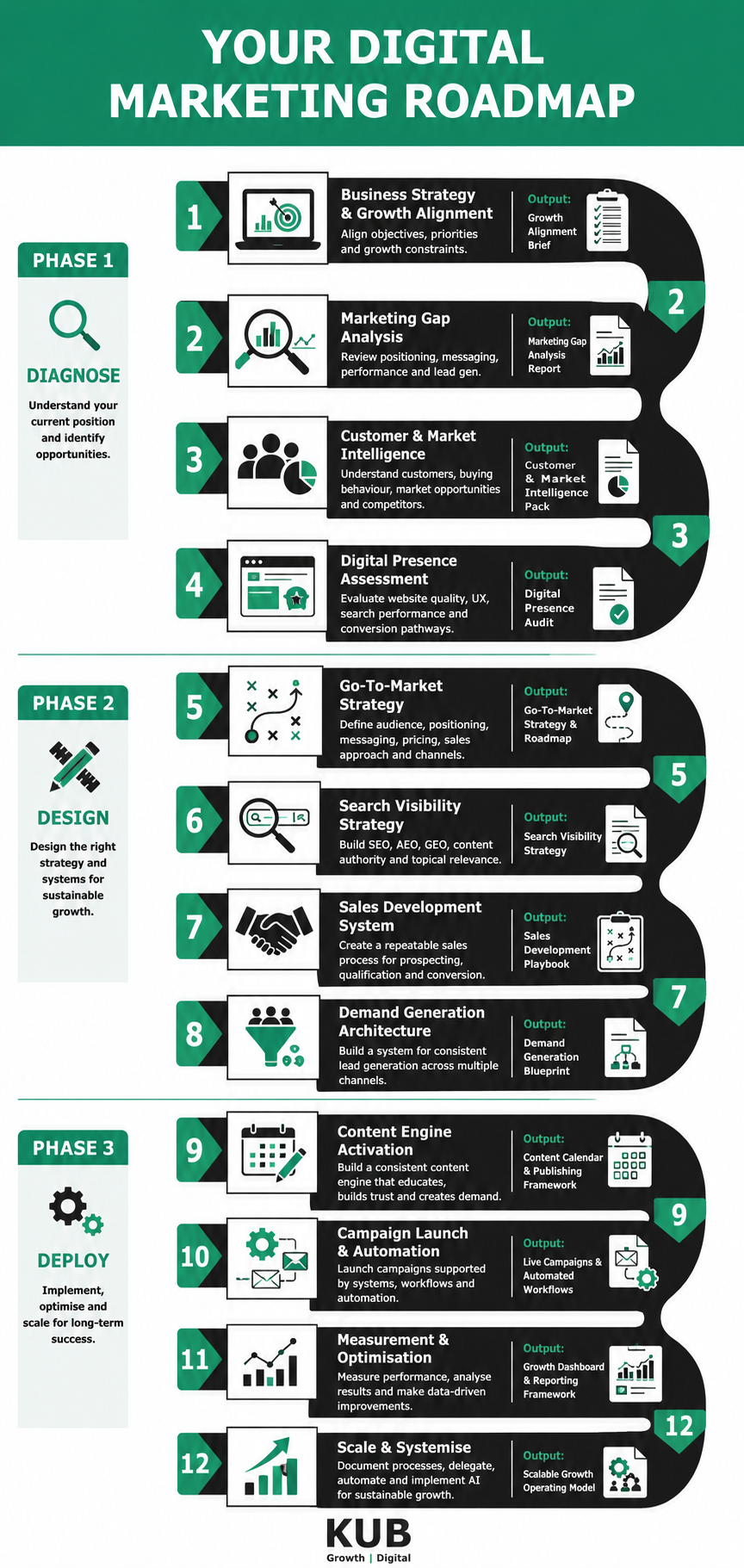
Phase 1: Diagnose
Before making changes, you need to understand where the business stands today.
Step 1: Business Strategy & Growth Alignment
Every growth initiative should begin with a clear understanding of business objectives. Ask: what are we trying to achieve? What does success look like? What constraints are limiting growth? What are our priorities? The goal is alignment between business objectives and future activity.
Output: Growth Alignment Brief
Step 2: Marketing Gap Analysis
Many businesses have marketing activity but no clear strategy. Review positioning, messaging, website performance, search visibility, content, and lead generation. The objective is to identify the biggest opportunities and weaknesses before committing resource to any single channel or tactic.
Output: Marketing Gap Analysis Report
Step 3: Customer & Market Intelligence
Growth becomes easier when you clearly understand your ideal customers, buying behaviour, market opportunities, and competitor positioning. The better you understand your market, the easier it becomes to communicate value — and the more precisely you can direct your marketing spend.
Output: Customer & Market Intelligence Pack
Step 4: Digital Presence Assessment
Your website and digital footprint often create first impressions. Review website quality, user experience, search performance, trust signals, and conversion pathways. The objective is to understand how effectively your digital presence supports growth — and what it would take to make it an asset rather than a liability.
Output: Digital Presence Audit
Phase 2: Design
Once you understand the current position, the next step is to design the future.
Step 5: Go-To-Market Strategy
This is where many businesses skip ahead too quickly. A Go-To-Market strategy defines target audience, positioning, messaging, pricing approach, sales approach, and channel strategy. Without a clear GTM strategy, execution becomes inefficient — teams work hard but pull in different directions.
Output: Go-To-Market Strategy & Roadmap
Step 6: Search Visibility Strategy
Search is changing. Businesses now need to think beyond traditional SEO. A modern search strategy includes SEO, Answer Engine Optimisation (AEO), Generative Engine Optimisation (GEO), content authority, and topical relevance. The objective is to ensure customers can find and trust your business — across both traditional search engines and AI-generated results.
Output: Search Visibility Strategy
Step 7: Sales Development System
Marketing creates interest. Sales converts opportunities. Businesses need a repeatable process covering prospecting, qualification, follow-up, pipeline management, and conversion. Growth becomes more predictable when sales processes are documented and consistently applied — rather than dependent on individual instinct.
Output: Sales Development Playbook
Step 8: Demand Generation Architecture
Lead generation should not rely on luck. A demand generation system combines content, search, LinkedIn, email, paid campaigns, referrals, and partnerships. The objective is to create a consistent flow of qualified opportunities that does not depend on the business owner's personal network or availability.
Output: Demand Generation Blueprint
Not sure where your roadmap should start?
Book a free consultation with Peter and leave with a clear view of which steps matter most for where your business is right now.
Phase 3: Deploy
Strategy only creates value when implemented.
Step 9: Content Engine Activation
Content should educate, build trust, and create demand. A structured content engine includes thought leadership, customer education, search content, social content, and email content. Consistency is more important than volume — a business that publishes one excellent piece of content per week will outperform one that publishes five mediocre pieces.
Output: Content Calendar & Publishing Framework
Step 10: Campaign Launch & Automation
Campaigns should be supported by systems and automation. Examples include CRM workflows, lead nurturing, AI-assisted research, reporting automation, and customer onboarding. Automation reduces manual effort and improves consistency — ensuring that no lead is missed and no follow-up is forgotten.
Output: Live Campaigns & Automated Workflows
Step 11: Measurement & Optimisation
Many businesses track activity but not outcomes. Key questions include: how many leads were generated, which channels performed best, what was the cost of acquisition, and what revenue was generated? Data allows better decisions — and the businesses that measure rigorously improve faster than those that rely on intuition alone.
Output: Growth Dashboard & Reporting Framework
Step 12: Scale & Systemise
The final stage focuses on creating a business that can grow without increasing complexity at the same rate. This often involves process documentation, delegation, automation, AI implementation, and leadership development. The objective is sustainable growth — a business that scales because of its systems, not in spite of them.
Output: Scalable Growth Operating Model
The Role of AI in Modern Growth
Artificial intelligence now influences almost every stage of the growth process. Businesses are using AI to conduct research, generate content, analyse data, improve productivity, automate administration, and support customer engagement.
The businesses gaining the greatest advantage are not replacing people with AI. They are enabling people to perform at a higher level — eliminating time spent on lower-value tasks so that teams can focus on the work that genuinely moves the business forward.
Want to see how this roadmap applies to your business?
Book a free consultation with Peter and get a structured perspective on which of the 12 steps will create the most impact — and in what sequence.
The Biggest Mistake Businesses Make
The most common mistake is focusing on tactics before strategy. Businesses often ask: should we run Google Ads? Should we use LinkedIn? Should we invest in SEO? Should we implement AI?
The better question is: what problem are we trying to solve? The answer determines the most appropriate solution — and prevents businesses from spending significant resource on channels that are unlikely to produce results given their current positioning, messaging, or sales readiness.
Final Thoughts
Growth is rarely the result of a single campaign, channel, or technology. It is usually the result of a structured approach that aligns strategy, marketing, sales, systems, and leadership.
The businesses that achieve sustainable growth are not necessarily the ones doing the most activity. They are the ones following a clear roadmap — executing in the right sequence, measuring what matters, and adjusting based on evidence rather than assumption.
If your business is struggling with inconsistent lead generation, unclear priorities, weak positioning, or a lack of strategic direction, the answer may not be another marketing tactic. It may be the roadmap itself. Our article on how to scale a business from £500K to £5M covers the strategic levers in detail, and our guide on why every business needs a 3-year growth plan helps set the longer-term horizon. The 12-Step Scale-Up Programme is the structured programme that delivers this roadmap in practice.
Frequently Asked Questions
A business growth roadmap is a structured framework that defines how a business will move from its current position to a specific future destination — covering strategy, marketing, sales, systems, and leadership. Unlike a traditional business plan written once for funding purposes, a growth roadmap is a living operational tool. It sequences activities in the right order, aligns the team around shared priorities, and creates a clear line of sight between daily execution and long-term commercial goals.
Start with diagnosis before design. Before deciding what to do, you need a clear understanding of where the business currently stands — its market position, customer profile, marketing performance, and key constraints. From there, a growth strategy should define the target customer and market, the positioning and messaging, the channels for demand generation, and the sales process for converting interest into revenue. The most effective growth strategies are simple enough to communicate clearly and specific enough to guide real decisions.
A go-to-market plan should cover six elements: target audience (who you are selling to and why they buy), positioning (how you are differentiated from alternatives), messaging (how you communicate your value clearly), pricing approach (how you are priced relative to value and competition), sales approach (how you convert interest into revenue), and channel strategy (where and how you will reach your target audience). Without all six, execution tends to be inconsistent — because different activities pull in different directions.
AI creates genuine productivity advantages at multiple stages of the growth process: market and customer research, content creation and distribution, reporting and data analysis, lead nurturing and follow-up, and operational automation. The businesses gaining the most benefit are not using AI to replace their teams — they are using it to eliminate time spent on lower-value tasks so that people can focus on higher-value work. For SMEs specifically, AI is levelling the playing field by making capabilities previously only available to large businesses accessible to smaller teams.
Most marketing strategies fail for one of five reasons: they are built on poor customer understanding, the positioning is unclear or undifferentiated, the messaging addresses features rather than outcomes, there is no mechanism for generating a consistent flow of leads, or there is no measurement framework to identify what is working. Marketing tactics applied without these foundations tend to produce activity rather than results — which is why many businesses feel they are doing a lot of marketing without seeing enough commercial impact.
A full 12-step growth roadmap typically takes 9–12 months to implement effectively. The diagnostic and design phases (steps 1–8) can usually be completed in 60–90 days. Deployment and the first cycle of measurement (steps 9–12) takes a further 3–6 months. Results from the early stages — improved positioning, a clearer website, and initial content — can often be seen within 60–90 days. Full commercial impact from demand generation and sales development typically becomes visible at the 6–9 month mark.
Ready to build your growth roadmap?
Book a free consultation with Peter. In 30 minutes you will have a clearer picture of where your business is on the roadmap, what is holding it back, and what to do next.
More on Business Strategy

Business Strategy
Why High-Growth Businesses Rarely Grow Alone
Behind most successful businesses is a network of people who provide guidance, challenge assumptions and help leaders make better decisions. The quality of advice surrounding a business owner is often one of the strongest indicators of future growth.
8 min read

Business Strategy
7 Business Lessons I Wish I'd Learned Earlier
After two decades and hundreds of client engagements, the same themes appear time and again. Seven honest lessons on strategy, customers, marketing, founder dependency and what consistent growth actually requires.
8 min read

Business Strategy
Who Really Owns Your Website? The Business Owner's Guide to Digital Asset Control
Most business owners assume they own their website — but that is not always true. This guide covers the five critical digital assets every business must control and what to do if ownership is unclear.
9 min read